Why I built it
Before a marketing team acts on a forecast, it needs to know whether the source data is usable and whether the model beats a simple alternative. This reusable local template checks campaign files, keeps a trace of their source, builds analysis tables and tests next-day bookings predictions against carrying today’s figure forward. It is an engineering template, not a connected advertising service.
What I chose
I made the data rebuildable from files through checked table layers to a dashboard. The prediction target is explicitly in the future and the model is compared with carrying today's figure forward.
What the example shows
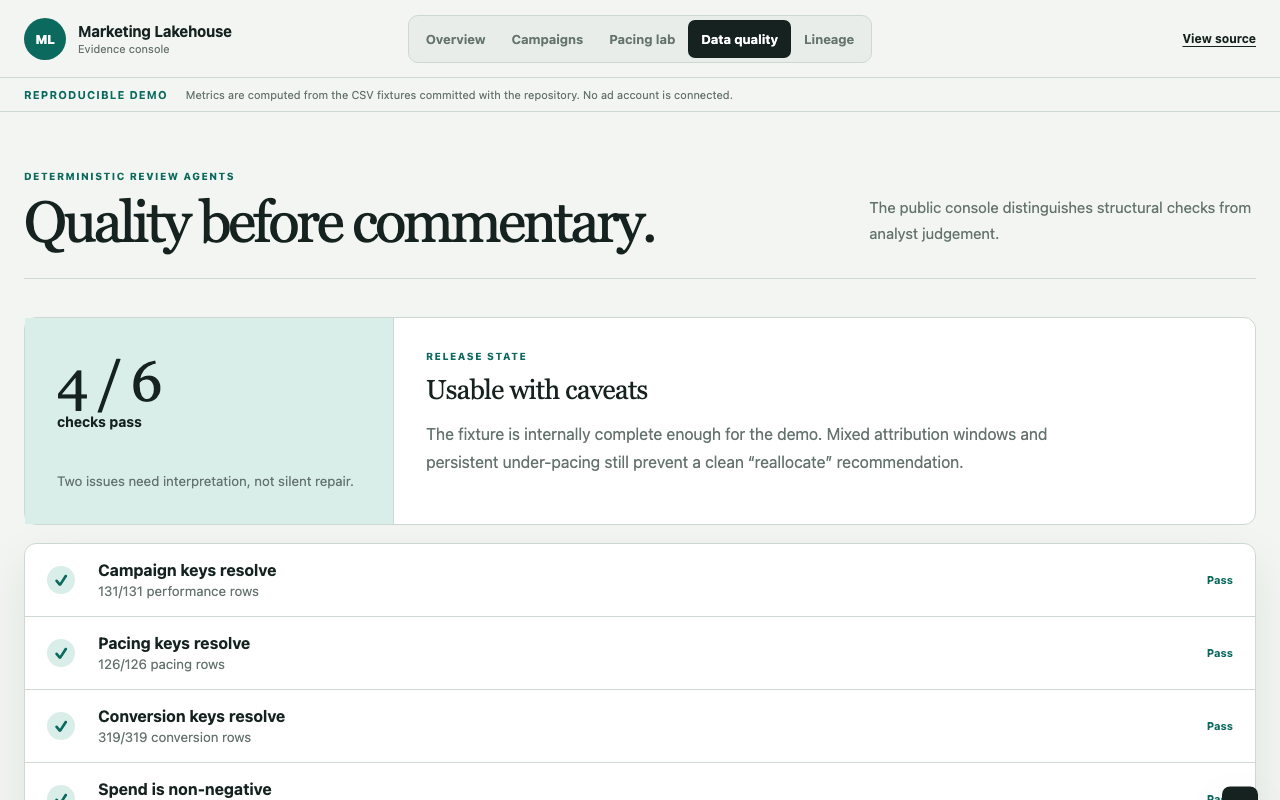
The public console is rebuilt from the pipeline's generated evidence on every push: data-quality warnings, lineage and the next-day model check. On the 24-row holdout the model's error intervals overlap the prior-day baseline's, so it shows no reliable skill yet.
What I learned
A polished forecast is not evidence that a model adds value. Data available only after the prediction time must stay out of training features, and a model needs to beat a simple baseline on later dates before its extra complexity is justified.